
The internet is changing—as it always has. With the rise of AI, the latest evolution feels different, though.
People are using AI to research more and more, and when they do visit a search engine, they’re often relying on AI overviews instead of clicking on the search results.
This change has businesses asking:
What does this mean for our digital marketing?
Does it really mean that SEO (Search Engine Optimization) is dead?
How will people find our website now?
Do we need a brand-new website strategy?
While there was an initial collective response to change everything, we have more data now—and that lets us know what we need to do to keep up.
The answer: GEO.
What exactly is GEO?
You may have heard the term “GEO” lately. It’s not a typo, and, while it isn’t exactly SEO (Search Engine Optimization), many actually prefer the term “SEO for AI.”
GEO, or Generative Engine Optimization, means writing and structuring your website content so that AI search tools will use it to answer more people’s questions in their results. In its essence, it is SEO for AI tools rather than search engines.
There may be fewer people clicking to your website, but that doesn’t mean they don’t see your website content in AI overviews and on AI platforms.
People are still searching, and they can discover your website, your expertise, and your offerings through AI with an SEO/GEO-optimized website.
How does GEO compare to SEO?
SEO is focused on what people type into a search engine, like Google, Bing, or Yahoo Search.
GEO is similar but is more focused on how people interact with AI tools to research and find answers.
Compared to how we’re used to getting data, GEO results show up in primarily two ways: AI overviews and generative (gen for short) AI chatbots.
Traditional Search Engines (SEO)
This is how we have all been researching on the internet for years. Type in your search query and get a list of websites that might have your answer.

More recently, there have been updates with voice search. “Hey Siri” or simply touching the microphone icon on your Google device will also bring up traditional or AI-driven search results.
AI Overviews (GEO in an SEO Environment)
By now, you have probably noticed the AI overviews popping up at the top of your search results.
In a search “what is the best way to learn Spanish,” Google.com provided me with the following information in its AI overview:
- A summary that provides an initial answer to my question
- Articles that I can click for more information
- Videos relevant to my search
- After clicking “Show more,” I have the opportunity to select, “Dive deeper in AI Mode,” where Google takes me to its generative AI chatbot to show me more in-depth answers.

Generative AI Chatbots (GEO)
ChatGPT, Copilot, Gemini, and Claude are all generative AI chatbots. Ask a question, and the chatbot shares answers with you.
You can have a whole conversation with the chatbot, get suggestions for a follow up question, or take any number of next steps like drafting emails or making a list.
Where does AI’s info come from?
This has been one of the biggest topics of conversation surrounding many AI conversations, including the adoptability, ethics, and use of generative AI.
Here, we’ll focus on how it fits in with your marketing strategy.
Some initial articles touted starting over with website optimization because SEO was no longer relevant, but, as more data become available, we got some really helpful information:
- Only rumored at first, multiple tests suggest that ChatGPT Plus is sourcing it’s answers primarily from Google Search results. (Search Engine Land)
- Research done by AI is increasing, but searches via Google’s search engine are still 210x bigger than ChatGPT searches. (Search Engine Land)
- Google’s own Liz Reid has said that AI isn’t replacing search… it’s augmenting it. (Corner Office Conversation)
In short, generative AI chatbots might share the information in a new way, but they are gathering information from the same place that a search engine does: the rest of the internet!
What does this mean for your business?
Why are businesses who have been working on their SEO for years ahead of the GEO game?
Because, unlike the initial reports that said SEO no longer mattered, marketing is still best when focused on one thing: your audience. This means understanding their mindset and the customer journey when they interact with your business.
For years, marketers have been hyper-focused on what people are searching: What keywords they are using, and then how you use those keywords across your webpages, in blog posts, in alt tags, and more.
And as search engines (particularly Google) adjusted their algorithms, your website content and SEO strategies had to be updated to keep search rankings high.
The shift to GEO / SEO for AI
Now, we shouldn’t just be concerned about what people are searching but where and how their mindset changes when they’re interacting with AI.
From what we at Creative Noggin have seen in the last few months, if you have been keeping up with SEO trends by writing content that shows your expertise, providing value to your audience, and being consistent with your marketing strategy…
(AKA a strong SEO strategy for your website…)
You have a head start to optimize your website for generative search!
Even if you haven’t focused on SEO, not to worry. You can always start an SEO and GEO strategy for your website.
How to optimize your website with a GEO strategy
Whether you’re starting from scratch or continuing your website optimization, here are 5 things we recommend doing for an AI-focused SEO/GEO strategy.
1. Use longer keyword phrases
One-word keywords used to be all the rage, but those have gone by the wayside in favor of more specific keywords and phrases. Now, with AI interaction, people are having conversations with AI chatbots, and their searches are conversational—not just a simple keyword or even a short phrase.
For example:
- One-word keyword search: hospital
- Keyword phrase search: San Antonio hospital
- Voice search: hospital near me
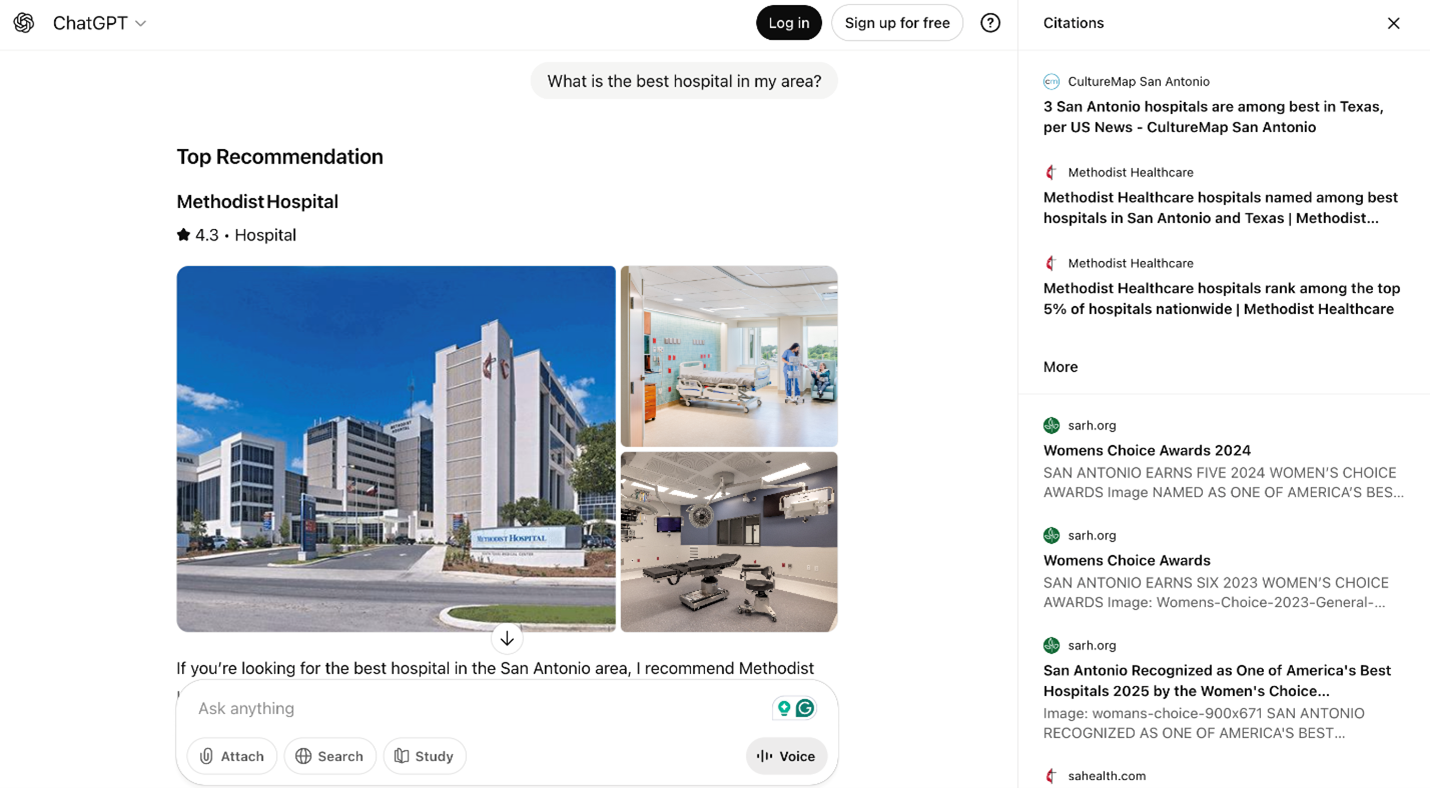
- Conversation with an AI chatbot:
What is the closest hospital to me with at least a 4.5-star rating?
[follow up] What are the top 3 and bottom 3 reviews?
[follow up] Who are the surgeons at the hospital?
[follow up] Do any of them treat [insert condition]?
[follow up] Are there any reviews about [insert doctor’s name]?
[follow up] Are there videos of the doctor?
Your website, focused on just a handful of short keywords, does not cut it to ensure your business keeps showing up in results with satisfactory answers.
Be specific and use longer phrases when optimizing your website for what people are searching for.
2. Content marketing is key
Remember years ago, when content was king? And then it wasn’t. And then it was again. And… then it wasn’t? So do we.
The thing about content is that it always matters, even if the way people consume content changes.
Today, people expect a variety of content from brands to help them connect to businesses. This can include:
- Engaging social content
- Video content
- In-depth blog posts
- Reviews from users
- Downloadable content
- Answers to specific questions
This content helps people get to your business and connect with your brand. But if you don’t prioritize content, what information are they finding about you?
3. Go deeper with your content
The internet, social media in particular, may be full of short blurbs and hot takes, but people are looking for more.
While some platforms are ideal for short videos (think TikTok or YouTube Shorts), longer videos, like podcasts or live streams, are highly engaging content.
Plus, when someone has made it to your website to decide whether they will purchase or engage with your business, they will simply leave if they can’t find what they need.
Know your target audience inside and out and provide them the information they’re looking for. Speak to those who have just found you and those who are ready to take the next step.
Content can be seasonal, educational, even fun. Find ways to show that you are an expert and that your brand is someone they want to engage with.
Looking for some help with writing your website content? Check out: 5 Tips on Writing Strong Website Content.
4. Create content where your audience is searching
Looking at the AI chatbot conversation above, the chatbot pulled information from the hospital’s website, reviews from around the internet, and available social media or YouTube content.
Where does that mean you should be putting out content?
- Your website
- A video channel, like YouTube
- Social media channels your target audience is using
- Reviews on sites like Google and Yelp (request these from happy customers!)
Support all of this organic content with ad campaigns across platforms to ensure people will see your brand. Then, follow up with email marketing.
Does this mean you have to come up with brand new content for every channel, all year long?
Actually, no!
This is one of our favorite marketing tips: Reuse your content! Create a video, turn it into a blog post, break the video and blog into smaller content pieces to share on social media and in newsletters, and use any one of these to create a piece of downloadable content.
Content catches attention and resonates with everyone differently. Plus, repetition is necessary for people to remember you.
5. Optimize for a great experience across the full customer journey
Are fewer people visiting your website, clicking on your ads, and clicking on your organic search results? Probably.
But the ones who do make it to your website are likely more interested in you and are likely further down the sales funnel. They’ve already done research on social media or with AI and they chose your website to visit to get what they need.
How are you going to reward them?
Think about the customer journey, make information and answers easy to find, and always provide a way for them to contact you.
You can also use a bit of AI on your site with your own chatbot. Your customer service team knows the questions that they’re asked most, and you (and your AI chatbot) can refine the text as you get more engagement.
The Bottom Line
The rise of GEO is not everyone’s cue to start over. All the work you’ve done building/ optimizing your website, managing your social media, and getting online reviews is working in your favor.
Now, you can build on what you already have for the next iteration of how people search for what you offer on the internet.
The same principles of marketing you’ve always heard about still matter:
Create good and engaging content that focuses on the customer and what they’re looking for.
👉Want a little help from the experts?
We are a team of marketing experts that partners with you to guide your marketing strategy and create authentic brands and marketing that helps you reach your business goals.
Reach out to us to talk to one of our marketing strategists today.