
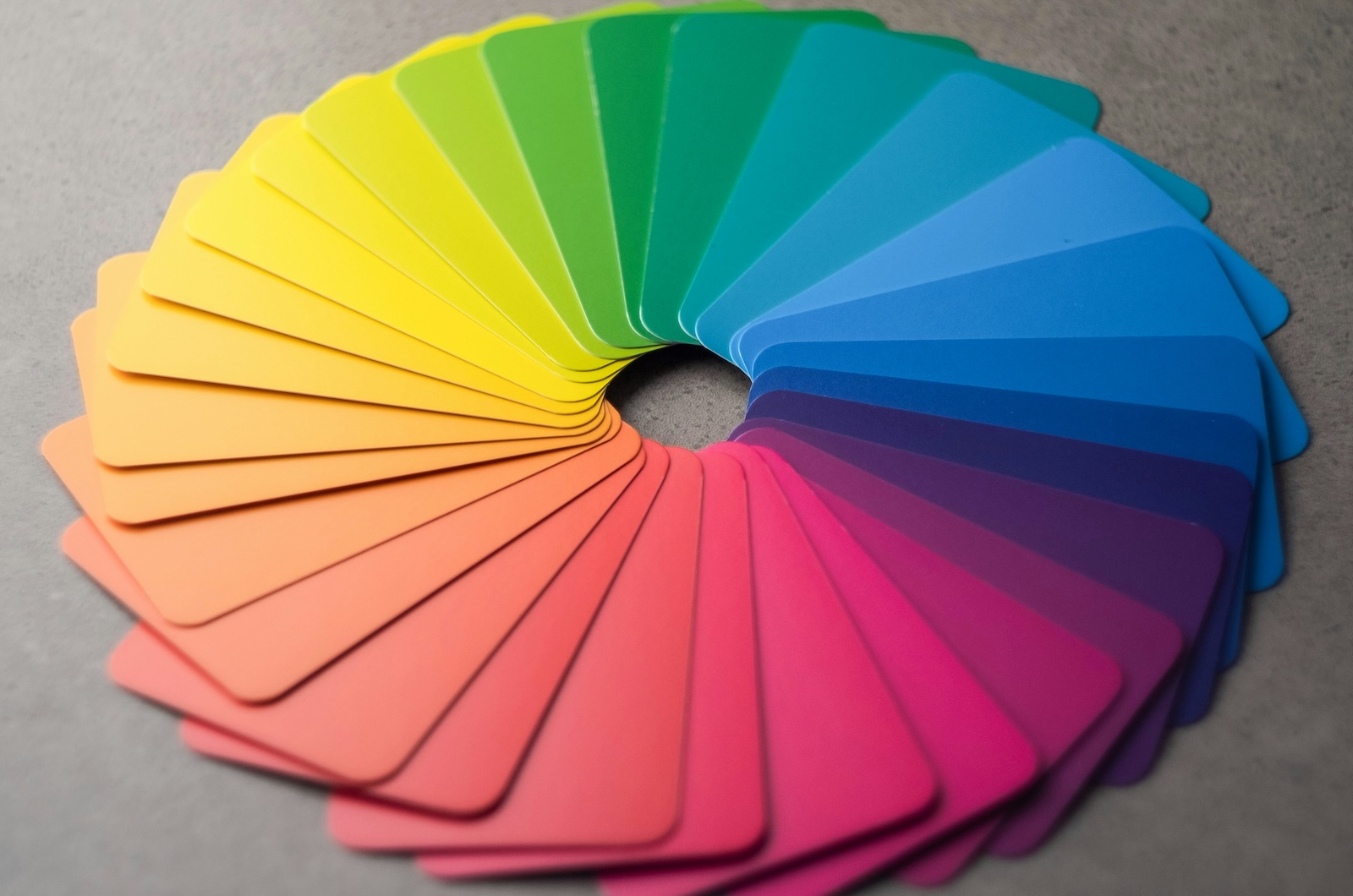
If you’ve ever looked at two designs with the exact same layout and copy—and felt drawn to one of them more (without being able to explain why)… odds are, color psychology was at play.
Color is one of the fastest ways your brain defines meaning. Color sets expectations. It nudges emotion. It signals “premium” vs. “budget,” “calm” vs. “urgent,” “modern” vs. “traditional.” In marketing, those tiny micro-signals add up—because people aren’t just buying a product or service. They’re buying into what it feels like to choose you.
Also? Color psychology is wildly misunderstood.
Because while color absolutely influences how we perceive brands, it’s not as simple as:
“Blue = trust. Red = excitement. Done.”
Context matters. Culture matters. Industry norms matter. And accessibility definitely matters.
So let’s talk about what color psychology really is—and how to use it in branding and marketing without falling into the pop-psych version of color theory.
Why color works (and why it’s not magic)
Researchers who study color and behavior tend to agree on one big idea: color carries meaning, and that meaning can influence people’s feelings, thinking, and actions—but it depends on the situation.
Colors’ impact changes based on what’s happening around it—your industry, your audience, your message, your cultural setting, and even the task someone is trying to complete. (Frontiers)
So yes—color matters. But no—there no universal “best” color.
There’s only the best color for this audience, in this category, trying to make this decision.
The shortcut your audience takes (before they read a word)
As much as we would like for prospective customers to read every word on our website and collateral, most people don’t approach marketing like a research project. They’re not carefully analyzing every word or claim.
They’re scanning.
They’re feeling.
They’re making quick judgments like:
- Does this look legit?
- Does this feel like me?
- Does this feel safe?
- Is this modern… or outdated?
Color is one of the first signals that helps them answer those questions.
A few common patterns we see (with a big asterisk)
Here are a few generalized color associations that show up often in research and in the real world—but again, context can flip them:
- Blue often supports perceptions of trust, calm, and competence. Studies have even found blue can increase trust compared to red in certain scenarios.
- Red can increase urgency or alertness—great for “act now” moments, but not always ideal for decisions that require calm, careful thinking.
- Green is frequently linked to health, nature, growth, and “good for you” cues (which is why it shows up everywhere from wellness brands to financial brands).
- Black + white often reads as premium, minimal, modern… or stark, depending on the category and how it’s paired.
- Purple can signal creativity or luxury (but can also skew “young” or “whimsical” if it’s too saturated).
If you’re thinking, “Okay, but I’ve seen brands break all these rules,” you’re right.
Because…
The most important rule: category expectations are real
Color doesn’t live in a vacuum. It lives inside a category.
For example:
- In healthcare, a lot of brands lean toward whites, blues, and greens because those colors cue cleanliness and calm. A bold red brand can work—but it needs to be handled carefully to avoid feeling alarming.
- In food, high-saturation reds and yellows are common because they can feel energetic and attention-getting—great for fast decisions at a distance.
- In finance, blues and neutrals often dominate because the category runs on trust cues.
But keep in mind:
If you match category norms too closely, you blend in.
If you fight category norms too hard, you risk confusing people.
The sweet spot is usually: be familiar enough to feel credible, but also distinct enough to stay memorable.
Where color does the most work in marketing
Color matters everywhere—but it tends to matter most in places where people make quick decisions:
1) First impressions (brand + website)
Your palette sets the “tone of voice” before someone reads your tone of voice.
2) Calls-to-action (CTAs)
This is where people go wrong by chasing internet myths like “the best button color is green.”
No. The best CTA color is usually the one that:
- fits your brand,
- creates clear visual contrast,
- and stands out within your own design system.
3) Social ads and thumbnails
Color helps you win the scroll. High contrast + a recognizable palette can make your content identifiable even before a logo appears.
4) Packaging and environmental design
If your product sits next to competitors, color can do instant positioning: bold vs. natural, premium vs. approachable, classic vs. modern.
5) Data visualization
Color can clarify—or completely confuse. A palette that looks “on brand” but collapses into mush when charted is… unfortunately common.
The part most brands skip: accessibility (and it’s non-negotiable)
If your audience can’t read your content, color psychology doesn’t matter.
For digital design, contrast is one of the biggest issues we see. WCAG guidance commonly referenced for readability includes contrast ratios like 4.5:1 for normal text and 3:1 for large text (with additional nuance depending on use case). (W3C)
That means:
- A beautiful pastel palette can be a branding asset…
- but you may need deeper supporting neutrals (or adjusted shades) for text, buttons, charts, and overlays.
Accessibility isn’t a creative limitation. It’s a creative standard.
A simple “Color Brief” you can use before choosing a palette
If you want a practical way to approach color strategically, here’s a framework we use:
Step 1: Define the emotional job
Ask: What should someone feel in the first 3 seconds?
Examples: grounded, hopeful, energized, safe, inspired, empowered.
Step 2: Map category norms (and decide how you’ll differentiate)
- What colors dominate your industry?
- Which ones are overused?
- Where could you be recognizable without feeling “off”?
Step 3: Build a palette with roles (not just vibes)
A functional palette usually includes:
- Primary color (the anchor)
- Secondary colors (supporting range)
- Neutrals (backgrounds, text, breathing room)
- Accent color (CTAs, highlights, moments of emphasis)
Step 4: Stress test it
Check:
- Contrast (especially on mobile)
- Legibility on photos
- Dark mode considerations (if relevant)
- How it looks for common forms of color blindness
- How it performs in charts and infographics
Step 5: Test in real marketing, not just a brand board
Mock it up in:
- a paid social ad
- a landing page CTA
- a header + body text section
- a chart
- a “busy” environment
Because color doesn’t live on a mock-up on your computer. It lives in the real world. Color consistency isn’t about being rigid. It’s about being recognizable.
The bottom line
Color is one of the most powerful tools in branding because it’s fast. It’s emotional. It’s memorable.
But the brands that win with color aren’t picking shades because:
- “blue means trust,” or
- “our competitor uses green so we should too,” or
- “we just like teal.”
The most effective brands don’t choose color based on trends or a one-size-fits-all chart. They choose a palette that supports:
- the emotional job their brand needs to do
- the expectations of their category
- clear, accessible communication
- and a consistent experience across every touchpoint
Because over time, color becomes more than decoration. It becomes memory. And in marketing, being remembered (for the right reasons) is half the battle.
 Thinking about color in your brand? Let’s talk. Our team helps businesses like yours design a brand identity that connects with your customers—today and for years to come.
Reach out to us here, and one of our strategists will be in touch!