
Ever notice how some brands just feel familiar, even before you really know what they sell?
Maybe it’s the tone of voice, the visuals, or just the energy behind the message.
Then there are other brands—perfectly designed, well-written, maybe even trendy—that somehow feel… flat.
That difference isn’t about budget or design tricks. It’s about personality.
And that’s where brand archetypes come in.
What Are Brand Archetypes, Really?
Archetypes are universal, timeless characters that live in stories, movies, and our collective imagination. They represent fundamental human motivations, like the desire to explore, to protect, to achieve, or to belong.
When applied to branding, archetypes become a sort of personality shorthand. They help audiences instantly “get” who you are and what you stand for.
Think of them as the DNA of your brand’s soul. They’re not a logo or tagline—they’re the foundation underneath it all.
Carl Jung, the psychologist who first identified archetypes, said these patterns exist deep within the human psyche. Modern brand strategists have simply translated that psychology into a framework for building emotional connection in business.
Why Archetypes Work: The Psychology Behind Them
Humans are wired for stories. We don’t just buy products or services—we buy into meaning.
Archetypes give people a story to believe in. When your brand consistently embodies one, your audience starts to feel something every time they encounter you. That emotional familiarity is what makes a brand memorable and trustworthy.
You probably already recognize some of these:
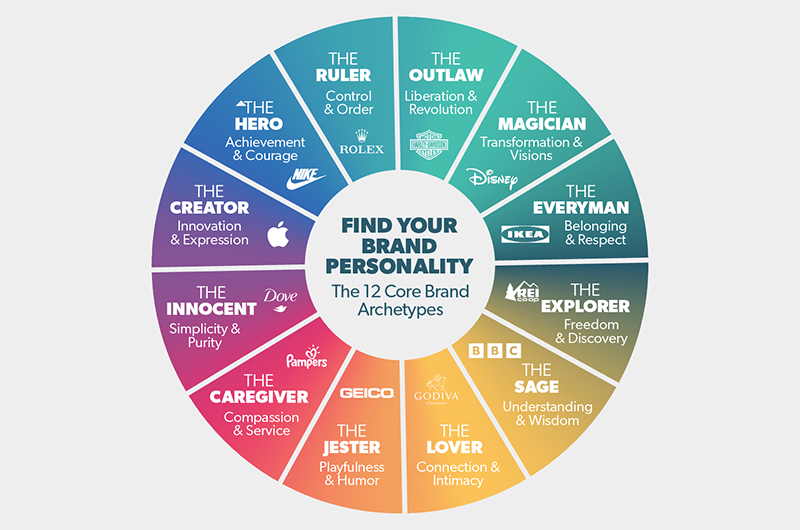
- Nike → The Hero, inspiring us to overcome obstacles and “just do it.”
- Dove → The Caregiver, focused on empathy, nurture, and self-acceptance.
- Harley-Davidson → The Rebel, defying convention and celebrating freedom.
- Disney → The Magician, promising transformation and wonder
Each one tells a story that transcends their product. That’s the power of an archetype in action.
How Archetypes Strengthen a Brand
Archetypes aren’t marketing fluff; they’re strategic tools that guide every decision, from messaging to design to culture.
Here’s how they work behind the scenes:
- Clarity
An archetype defines what your brand is, and just as importantly, what it’s not. It becomes your filter for tone, imagery, and even opportunities that fit your identity.
- Consistency
When everyone on your team understands the brand’s personality, you stop reinventing the wheel. Every campaign, post, and presentation aligns naturally.
- Connection
Archetypes speak directly to emotion. They allow audiences to relate to your brand the way they relate to characters in a story—through shared values and familiar motives.
- Culture
Internally, an archetype helps unify teams. It gives employees a clear sense of who the brand is and how to represent it, turning your mission statement into lived behavior.
How to Identify Your Brand Archetype
Discovering your archetype isn’t about picking a label from a list. It’s about uncovering who your brand truly is at its core.
Start by asking yourself three questions:
- Why do we exist?
Go beyond profit. What purpose drives your organization? - What does our audience need emotionally?
Are they seeking freedom, belonging, confidence, security, inspiration, or something else? - How do we behave and communicate?
Look at your tone, visuals, and customer experience. What personality naturally shines through?
When you align your purpose, audience, and behavior, your archetype usually reveals itself.
Here’s a snapshot of a few archetypes you might encounter:
| Archetype | Core Desire | What It Promises |
| Hero | Mastery & Achievement | “You can overcome anything.” |
| Caregiver | Compassion & Service | “You’re safe and supported.” |
| Explorer | Freedom & Discovery | “Go find your own path.” |
| Creator | Innovation & Expression | “Let’s build something amazing.” |
| Sage | Understanding & Truth | “Knowledge leads to growth.” |
| Lover | Connection & Intimacy | “You are seen and valued.” |
You’ll find echoes of each in brands across industries—from hospitals to banks to travel companies—because archetypes aren’t about what you do. They’re about how you make people feel.
The Risk of Being a Wallflower
When a brand lacks a defined archetype, it becomes forgettable. You end up with nice visuals but no heartbeat—a collection of tactics without a consistent voice.
Your audience shouldn’t have to decode who you are. When they can’t sense your brand’s personality, they move on to one that feels more familiar and trustworthy.
Think of it this way:
If your brand walked into a room, would people recognize its energy and point of view?
Or would it blend quietly into the wallpaper?
Bringing It All Together
Your brand already has a personality—the question is whether you’ve defined it on purpose.
When you identify and live out your archetype, you bring coherence to everything you do: your marketing, your culture, and your customer relationships. You stop trying to be everything to everyone and instead start becoming unmistakably you.
Archetypes give your brand a soul. And when your brand has soul, people don’t just remember you—they root for you.
👉 Thinking about what your brand archetype is? Let’s talk. Our team helps businesses like yours clarify your story and design a brand identity that connects with your customers—today and for years to come.
Reach out to us here, and one of our strategists will be in touch!